Showing posts with label Electronics Lies. Show all posts

Monday, 18 January 2016

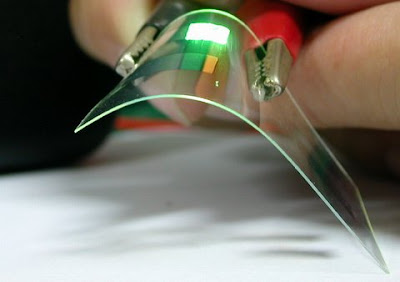
Flexible Transistors Lead an Electronics Revolution

FlexEnable, a transistor developer in the UK recently stated that the automotive industry is one of the places where flexible displays are gaining ground.

The firm which is based in Cambridge, is in the process of completing quite a few number of projects for the automotive industry after coming in contact with the interested parties in the 2015 edition of International Motor Show held at Germany in the month of September.


It has forged a partnership with the firm Flextronics which designs and manufactures electronics. FlexEnable has tied up with several Tier 1 suppliers of solutions in the industry of automotives.

Flexible electronics are being planned to be integrated with automobiles in the following ways:

  • They are considering putting in place a display on either side of the windshield, commonly referred to as the “A pillar”, which serves to eliminate the problem of the blind spot. So, naturally it has to be curved.
  • Other uses of flexible electronics in the world of automobiles involve putting in place a passenger display at the back of the headrest so that it is safer and does not add to the weight that much.

The Market for Flexible Displays

Earlier, in the initial parts of 2015, the company made a demonstration of an organic LCD, abbreviated as (O)LCD in the A pillar . It has already entered into several NDAs with firms in this particular area relevant to developments of commercial nature.

The consultancy IHS Automotive, predicts vehicle sales provided with such touchscreen interfaces will gain ground from 16.7 million pieces in 2015 to more than 61 million pieces in the year 2021.

In addition to the displays, automotive parts present several opportunities potentially, in the area of flexible and printed electronics in applications related to sensors and lighting. Among the large number of companies, including the automotive giant BMW,plan to integrate electronic lighting that is organic in nature as one of the constituent parts of their vehicles.

Flexible Transistors
FlexEnable is a provider of the flexible transistor, a technology platform which may be fused with LCD or OLED displays in addition to sensors of various sorts and other components of electronics. Aside from automotives other uses might be in fields like medical imaging, consumer and security electronics regarding applications.

There are numerous places where there is need of an active surface like x-ray imaging, sensors of biometric nature like sensors regarding veins, fingerprints or pressure to consumer electronics displays and also advertising and signage.

There are plans by the company to licence the relevant technology to partners in the supply chain and open up a manufacturing unit in Asia in the later parts of 2016.
By 2018 the company aspires to be able to produce such electronic units in very high volumes in the year 2018.

Electrodiction

If you are an amateur hobbyist or a professional looking to switch career paths, electronics training as imparted through electronics video like those provided by Electrodiction may prove to be of invaluable help.

Related News


Monday, 10 August 2015

OBAMA BACKED REPLACEMENT PART RECOGNITION APPLICATION

On Tuesday, 4th August of 2015 a conversation was held with the president Barak Obama at the White House for a Demo Day where the entrepreneur from Atlanta, Ga., Jewel Burks had the most precious chance of conversing regarding her initiative of Partpic.

OBAMA BACKED REPLACEMENT PART RECOGNITION APPLICATION

Jewel Burks along with the co-founder Jason Crain explained the ways they came up with the idea of launching Partpic which is an application developed for the purpose of helping companies recognize and order the exact replacement part for getting back their machines’ functionality.

From her experience of working in a parts call center and her childhood occurrence of helping her grandfather into getting a replacement part for his tractor helped her to turn up with the idea of this company. Her desire to help people out in searching for the part needed for their machines is what that drives her into this endeavour.

What was most inspiring for Burks, the President showed genuine interest in understanding the comprehensive details of the company. At the Demo Day, Burks’s company was one of the 30 start-ups and 90 entrepreneurs who were all invited to take a role in the initiative taken on the part of the administrative that will encourage many to include in the tech industry.

Obama cited that if the companies on a global scale continue to put stress in employing diverse leadership, there will create more scope for opportunity. The lack of participation is possibly the reason that the companies are not doing good. In this occasion Obama had been more particular in mentioning that women CEOs are employed in less than 3% venture capital-backed companies, at the same time, less than 1% companies have an African American as their founder.

The president announced that miscellany initiatives will be taking place with new public-private tech firms along with more than 40 leading venture capital firms for the purpose of increasing varied practices for hiring and funding. The co-founder of The Electronic Frontier Foundation and his wife Freada Kapor have committed a $40 million investment for the development in the tech sector.

Adding to the success of Obama’s administration, over 100 engineering schools have pledged to TechHire initiative that will focus on diversity hiring and more comprehensive student enrolment. 

 Related News

Friday, 7 August 2015

Flexible Paper can Emit Light

Since the first emergence of technology, the evolution never stopped.And now in the present age of rapid advancement of smart gadgets another extraordinary collection has been added into the list of smartproducts – the firstever light-emitting, transparent and flexible paper. 

 Bendable Technology with Light-emitting Flexible Paper


The evolution of smart technology added many gems into its list – from phones to tablets and then watches and glasses. However, these inventions could not eradicate the barrier of rigidity. Now the Researchers from China have reported that they have developed light-emitting, transparent and flexible paper – a technology that takes one step ahead to the revolution of bendable electronics.

This transparent, flexible and light-emittingpaper is reported to be environmentfriendly that has been made out of similar eco-friendly materials using a simple anda greater rate of filtration technique.

It has been long predicted by the technology experts that the age of flexible electronicsis coming, and researchers are working diligently on severalfacades to find a way towards that goal. Sincemost of the progressesdepend on petroleum-based plastics and toxic materials, Yu-Zhong Wang, Fei Song and their colleagues in China wanted a solution in a “greener” way.

In this endeavor, Yu-Zhong Wang and Fei Songled a team of researchers who were material scientists at Sichuan University, China. About the research and the outcome have beenissuedin the American Chemical Society's journal Applied Materials and Interfacesthis week.


What thescientists wrote in their new paper is pretty inspiring, "This material can bring a new thinking on future electronic displays and 3D printing papers". The paper that the researchers developed is a thin, clear nanocellulose paper prepared out of wood flour and later suffused it with biocompatible quantum dots. These arelittle, semiconducting crystals which are made combining zinc and selenium. What is interesting is that this paper glows at room heat and can easily be rolled and unrolled without the fear of cracking it.

 Related News

http://www.techtimes.com/articles/54828/20150522/scientists-develop-light-emitting-paper-that-might-shape-future-of-bendable-electronics.htm

Monday, 27 April 2015

The Fate of Future Electronics Lies on Carbon Nanotubes


The unique properties of Carbon Nanotubes, the tiny molecular cylinders, have enticed researchers for years because of the possibility that they could serve as the successors to silicon serving as the electronic devices that are smaller, faster and cheaper.

First, they are tiny on the atomic scale and perhaps close to the physical limit of how small you can reduce a single electronic switch. Like silicon, they may be of semi-conductive nature, which is essential for the circuit panel, and they may endure very rapid and controllable electrical switch.
Source: http://goo.gl/Uim7L4

But the major obstacle to useful electronic construction out of carbon nanotubes has always been that when they are placed in films, few parts of them act more like a metal than a semiconductor. This defect can spoil the entire film.

In effect, Professor John Rogers of University of Illinois professed that purity must exceed 99.999%, i.e. even a bad tube in 100,000 is enough to kill an entire electronic device. These kinds of materials will not work for semiconductor circuits.

Currently Rogers with the help of a team of researchers have experimented using rather easy, scalable method that does not involve costly tools to strip out the metallic carbon nanotubes from assortments.

Benefits of Carbon Nanotubes:
Carbon Nanotubes have multiple exceptional advantages, comprising of:
  • High thermal and electrical conductivity
  • Optical properties
  • Flexibility
  • Increased rigidity
  •  High tensile strength (100 times stronger than steel by weight)
  •   Lightweight

Applications of Carbon Nanotubes:
  • At present Carbon nanotubes are applied in different products, and researchers are looking forward to discover new creative applications.
  • Current applications include:
  •   Bicycle components
  • wind turbines
  • Flat screens
  • Scanning probe microscopes
  • Detection devices
  • Electrical circuits
  •  Electronic and many more
  • Future uses of carbon nano tubes are quite interesting which include:
  • Stab-proof and bullet-proof Clothing
  • Semiconductor materials
  • Spacecraft
  • Space elevators
  • Solar panels
  • Cancer treatment
  • Touch screens
  •  Energy storage
  •  Optical technology
  • Radar
  • Biofuel 
  •   LCD
·         Submicroscopic test tubes
CNTs are very new material with little continuing history. Although no human has yet fallen ill due nanotubes, nevertheless scientists urge caution while handling nano particles. The potential health risks are not cause for alarm and the future of Carbon Nanotubes is quite bright in the world of electronics