Friday, 7 August 2015

Flexible Paper can Emit Light

Since the first emergence of technology, the evolution never stopped.And now in the present age of rapid advancement of smart gadgets another extraordinary collection has been added into the list of smartproducts – the firstever light-emitting, transparent and flexible paper. 
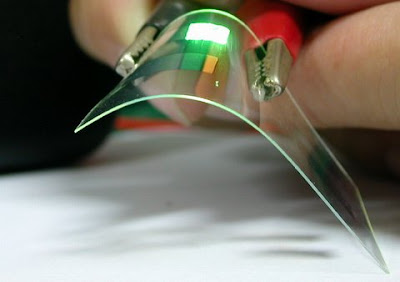
 Bendable Technology with Light-emitting Flexible Paper


The evolution of smart technology added many gems into its list – from phones to tablets and then watches and glasses. However, these inventions could not eradicate the barrier of rigidity. Now the Researchers from China have reported that they have developed light-emitting, transparent and flexible paper – a technology that takes one step ahead to the revolution of bendable electronics.

This transparent, flexible and light-emittingpaper is reported to be environmentfriendly that has been made out of similar eco-friendly materials using a simple anda greater rate of filtration technique.

It has been long predicted by the technology experts that the age of flexible electronicsis coming, and researchers are working diligently on severalfacades to find a way towards that goal. Sincemost of the progressesdepend on petroleum-based plastics and toxic materials, Yu-Zhong Wang, Fei Song and their colleagues in China wanted a solution in a “greener” way.

In this endeavor, Yu-Zhong Wang and Fei Songled a team of researchers who were material scientists at Sichuan University, China. About the research and the outcome have beenissuedin the American Chemical Society's journal Applied Materials and Interfacesthis week.


What thescientists wrote in their new paper is pretty inspiring, "This material can bring a new thinking on future electronic displays and 3D printing papers". The paper that the researchers developed is a thin, clear nanocellulose paper prepared out of wood flour and later suffused it with biocompatible quantum dots. These arelittle, semiconducting crystals which are made combining zinc and selenium. What is interesting is that this paper glows at room heat and can easily be rolled and unrolled without the fear of cracking it.

 Related News

http://www.techtimes.com/articles/54828/20150522/scientists-develop-light-emitting-paper-that-might-shape-future-of-bendable-electronics.htm


Wednesday, 5 August 2015

In Collaboration with Micron Intel Launched 3D XPoint Memories

On the 28th of July, 2015 in London, the company executives of the Intel and Micron Technology launched the first category of memory that is described by both the companies as a major development after 1989 when the NAND flash was first emerged. It is the 3D XPoint memory IC with 128Gbits capacity which according to a primary finding is a fixed memory that reveals a massive capacity for material property change where the metal access lines meet at a cross-point.

What you need to know about vaping hazards of E-Cigarettes


The buzz is already around the electronics industry that this memory may possibly bring a major revolution. It is hoped that this memory will be faster up to 1000 times than NAND flash. Also the density of the memory is 8 to 10 times more than DRAM, making the cost relatively low. The applications of 3D XPoint memory are predicted to be lucrative for the data centers and the solid-state drives.

According to the CEO of Micron Mark Durcan that this is the result of the joint venture between Intel and Micron built in 2006. It was being produced at the wafer fab in Lehi, Utah, which belongs to IM Flash Technologies LLC. The Micron CEO further enforces that the memory is structured in a way that it will remain as two planes of 64Gbits where one bit will be quantified for each cell.

The engineering details were disclosed at the launch event as well. According to the Intel and Micron while creating the 3D XPoint memory they were stressing on inventing material compounds that will be unique in nature. They did not disclose much about the switching mechanism but hinted that it is by means of modifications done in resistance of the bulk material.


There are similarities of 3D XPoint to ReRAMs developed by Crossbar Inc. as it is a resistive RAM with a select integral diode making an opaque structured device. But it has been confirmed that 3D XPoint cannot be pertained and comparing to other forms of stable memory, the 3D Xpoint is fundamentally a special switch made for bulk-switching mechanism. 


Related News

http://www.c-sharpcorner.com/News/4965/intel-and-micron-collaborate-to-launch-3d-xpoint-technology.aspx

Monday, 27 April 2015

The Fate of Future Electronics Lies on Carbon Nanotubes


The unique properties of Carbon Nanotubes, the tiny molecular cylinders, have enticed researchers for years because of the possibility that they could serve as the successors to silicon serving as the electronic devices that are smaller, faster and cheaper.

First, they are tiny on the atomic scale and perhaps close to the physical limit of how small you can reduce a single electronic switch. Like silicon, they may be of semi-conductive nature, which is essential for the circuit panel, and they may endure very rapid and controllable electrical switch.
Source: http://goo.gl/Uim7L4

But the major obstacle to useful electronic construction out of carbon nanotubes has always been that when they are placed in films, few parts of them act more like a metal than a semiconductor. This defect can spoil the entire film.

In effect, Professor John Rogers of University of Illinois professed that purity must exceed 99.999%, i.e. even a bad tube in 100,000 is enough to kill an entire electronic device. These kinds of materials will not work for semiconductor circuits.

Currently Rogers with the help of a team of researchers have experimented using rather easy, scalable method that does not involve costly tools to strip out the metallic carbon nanotubes from assortments.

Benefits of Carbon Nanotubes:
Carbon Nanotubes have multiple exceptional advantages, comprising of:
  • High thermal and electrical conductivity
  • Optical properties
  • Flexibility
  • Increased rigidity
  •  High tensile strength (100 times stronger than steel by weight)
  •   Lightweight

Applications of Carbon Nanotubes:
  • At present Carbon nanotubes are applied in different products, and researchers are looking forward to discover new creative applications.
  • Current applications include:
  •   Bicycle components
  • wind turbines
  • Flat screens
  • Scanning probe microscopes
  • Detection devices
  • Electrical circuits
  •  Electronic and many more
  • Future uses of carbon nano tubes are quite interesting which include:
  • Stab-proof and bullet-proof Clothing
  • Semiconductor materials
  • Spacecraft
  • Space elevators
  • Solar panels
  • Cancer treatment
  • Touch screens
  •  Energy storage
  •  Optical technology
  • Radar
  • Biofuel 
  •   LCD
·         Submicroscopic test tubes
CNTs are very new material with little continuing history. Although no human has yet fallen ill due nanotubes, nevertheless scientists urge caution while handling nano particles. The potential health risks are not cause for alarm and the future of Carbon Nanotubes is quite bright in the world of electronics

Sunday, 1 March 2015

Top 10 Electronics Engineering Websites for Beginners

Electronics engineering training is a bold and awesome.  The one thing that makes Electronics so much fun is the application of science in everyday life. Complied below are the top websites related to engineering and electronics that kindle interest in the learner’s mind from the beginner’s level as you plough your way to be a pro pretty soon.

Apart from the traditional Wikipedia and Google, here’s my list of ten best websites to visit if you have passion for electrical/electronic engineering.       
Source: http://goo.gl/QWGoGx


1.      Instructables.com—offers a great range of cool user-generated “do-yourself” projects from 3D printing to cheese-making. Created by Eric Wilhelm and Saul Griffith, it encourages users to try out new things. Why for electronics engineers? When B-Tech books are weighing you down, it’s a great way to unleash your fun side and inspire yourself to dummy run your own projects.

2.      Openelectrical.org—throws light on practical applications along with what is being studied at school. It affords great help for students who want to become successful practitioners in the industry.   
3.      Electrodiction.com—offers video tutorials on analog, digital electronics, microprocessor and microcontroller and network theorem in clean neat chapters of designed with all videos and no texts. This attracts tech students a great deal worldwide.  
4.      Ocw.mit.edu—Eminent professors sharing news and reviews, tips and tutorials. 2,200 online courses are available along with the text material offered to its on-campus students. 
  
5.      Ieee.org—Tutorial on newest technologies and innovations. The community’s a great motivation-booster for aspiring electronics engineers.  
 
6.      societyofrobots.com—though it is aimed for students of advanced level, fascinating projects with microcontrollers are given here in a clear, understandable way.   

7.      stackoverflow.com—have a query regarding your CEng or B.Tech projects or theory applications? Derive opinions from a pool of experts.  
8.      forum.allaboutcircuits.com—diverse queries related to electronics science homework are asked and replied to. This website is very helpful to solve your doubt about a textbook material.  
 
9.      sparkyuonline.com—expert electricians offering “hands-on “training to novices. Great “how-to” instructions to boost your real-world knowledge.     
 
10.  engineergirl.org—this engineering website offers pure fun and utility side by side. An array of colours and exciting topics, it sure relives your pain of cramming textbooks to a great deal, when you realize you thrilling the world of engineers really is.
   

Students and hobbyists know how fascinating it is to have first-hand experience with ‘live’ stuff when other career trackers are stomaching theories from books. Applications are fun! So are Electronics Engineering Training online! 

Wednesday, 18 February 2015

Volta Turns 270—the Man who said No to Priesthood and Yes to Electricity -2015


It’s February 18, Alassandro Volta’s birthday! You probably already got an air of who he was when you saw the doodle on Google—the Italian physicist and battery-inventor.  But, for electronics science aficionados, he is a legend who bravely fought against the adversities of his time.
The man’s story goes long before “voltaic pile”—the first original battery and ‘Volts’ the unit of electric current to credit his name. Even before the discovery of methane gas and al that hullaballoo over electrostatics, pneumatics and meteorology. In 1745, Volta was born in the beautiful town of North Italy, Como. Volta had a noble family background.


  • A Hidden Diamond

Alessandro Volta was thought to be slow-witted and dull in the primal phase of his life. But, the diamond didn’t stay hidden for long, as his father recognised later as Volta began to shine in class. His sudden improvement   left everyone amazed. However, his parents insisted that he should take up priesthood which he kept resisting. 

The man had burning interest in something else! At the age of 18, Volta had the guts to exchange letters on Electricity with two hugely popular physicists of his time: Giambatista Beccaria and Jean-Antoine Nollet.

  • Controversy over Frog’s Leg Led to Invention of Battery! 

Alessandro Volta never aspired to invent battery in the beginning. It was his dispute with Galvani that compelled him to explore further on the matter. Galvani was an Anatomy professor. He noticed that contact with different metals make a frog’s leg ‘twitch’ which he referred to as “animal electricity”.  
Alessandro Volta studied Luigi Galvani’s theory and felt something was wrong with it. He ran multiple experiments on this and finally something struck him like a lightening. Two different metals are causing the twitch but similar metal causes no movement in the dead muscle at all. 


Then Alessandro Volta came to know that not only two different metals generate electrical effect, but such metals, when in contact with particular types of fluid create such effect.  Born was the first electric battery from this experiment in 1800. 

Now we understand what Galvani did was to create an electric cell unknowingly.  The frog’s leg acted like an electrolyte that fuelled the flow of electricity. Browse through free electronics video tutorial to dig fun projects as such.